
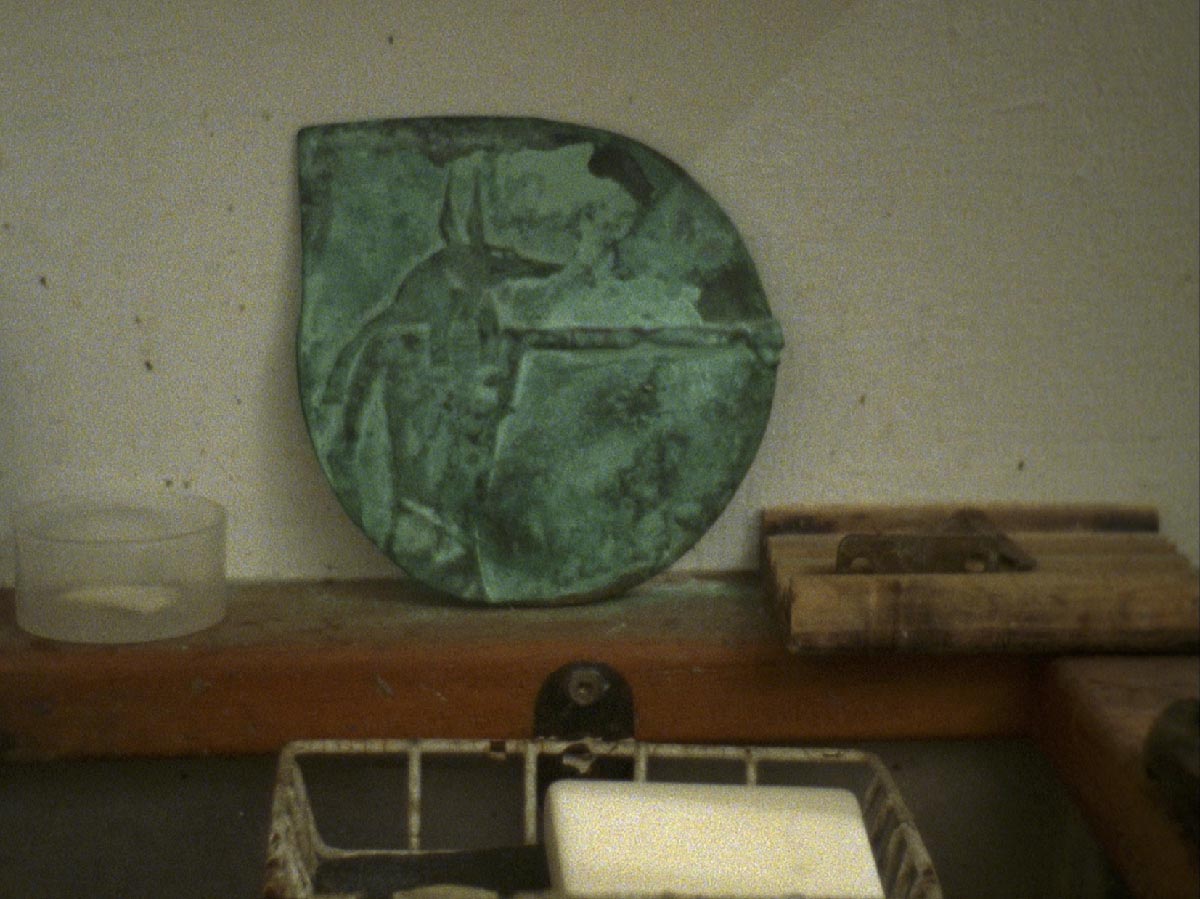
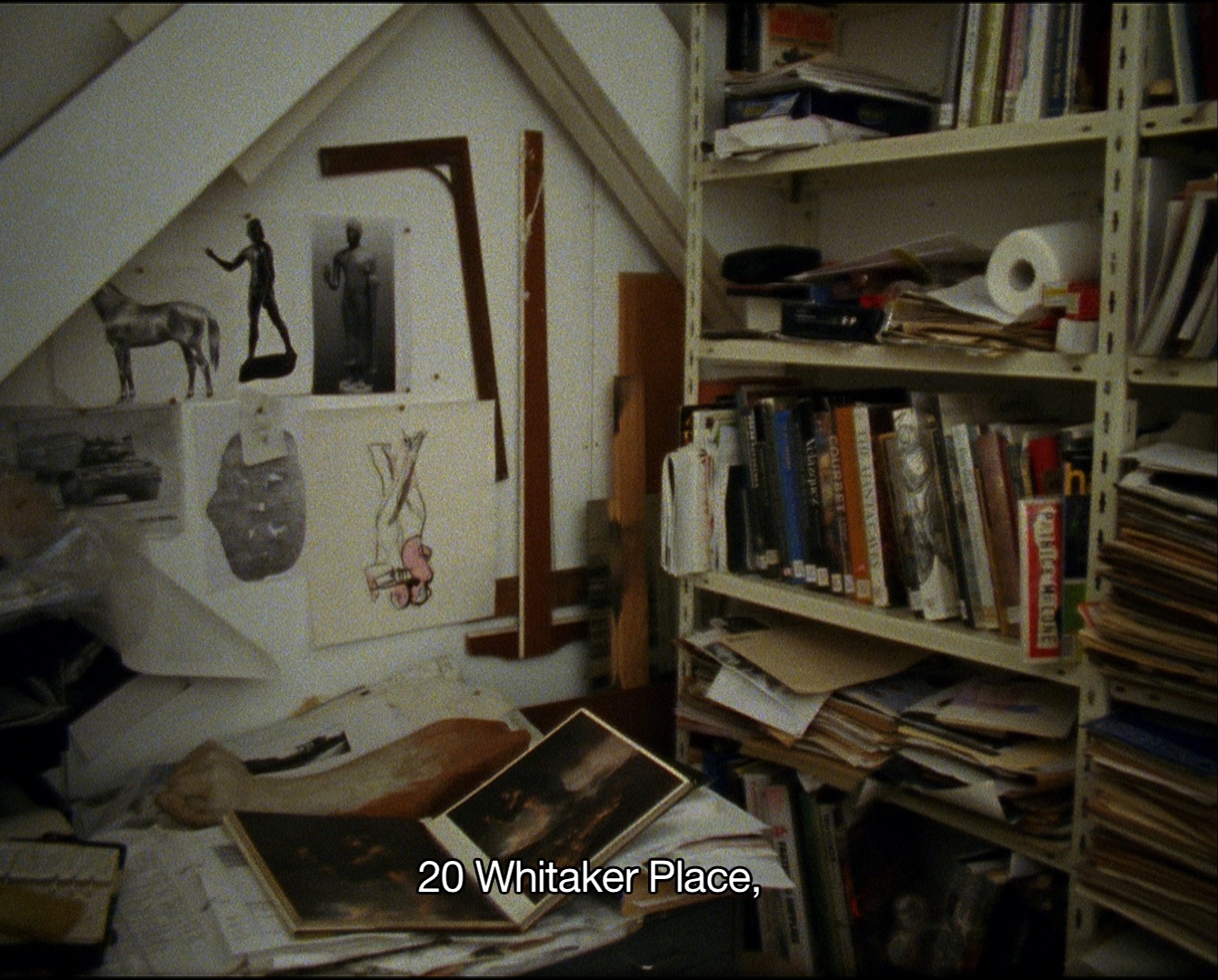
Louise Menzies, still from Sculpture/Metal, 2012, 16mm film transferred to video, single channel, high definition (HD), 16:9, colour, silent, 4min 15sec, Chartwell Collection, Auckland Art Gallery Toi o Tāmaki.
To mark 50 years of creative impact, The Chartwell Project and Auckland Art Gallery Toi o Tāmaki co-published Being, Seeing, Making, Thinking: 50 Years of The Chartwell Project. Of the 486 Chartwell artists acknowledged in the book at time of publication, 150 works were featured with full page images, each selected to reflect The Collection's evolution and vision over five decades. The Appendix extends this story. This ongoing series of artist interviews spotlights artists not featured in that group of 150, offering deeper insight into individual practices and the wider significance of The Chartwell Collection.
Louise Menzies is an Auckland-based artist whose practice operates at the intersection between image and language—creating films, artist books, installations, and performative works. Her work often reflects on shared experiences, intangible encounters, and language in its myriad forms.
In this instalment of The Appendix, Menzies discusses her 2012 moving image artwork Sculpture/Metal. Chartwell is pleased to host the work on The Journal from September 1 through October 11. Watch below, then read our discussion of the work.
Chartwell: Sculpture/Metal combines filmmaking tools from documentary, essay, sculptural film, and collage. How would you characterise this artwork?
Louise Menzies: To use a genre term, I would say it is a portrait: of an artist, Graeme Brett, and of their studio, which also happens to be their workplace. Graeme was the Elam technician for what was then called the 3-D Hub. He studied at Elam, became a technician in 1973, and remained there until he retired in 2016.
The official address of this room was "Sculpture/Metal". It was his office, but as a student and an artist, popping in and out of that room, it always struck me as a studio. I remember someone telling me that, for a while when his children were young, Graeme would stay over on Wednesday nights. He would work into the evening, climb into the loft bed he had built, and then be at work the next morning. That was his “studio day”.
This and many other small snippets of history were quietly tacit in that room, waiting for the right sort of question to be unravelled. Graeme was an unassuming holder of what is probably a quite vast amount of institutional memory.
Chartwell: How did you come to see this as a subject for an artwork?
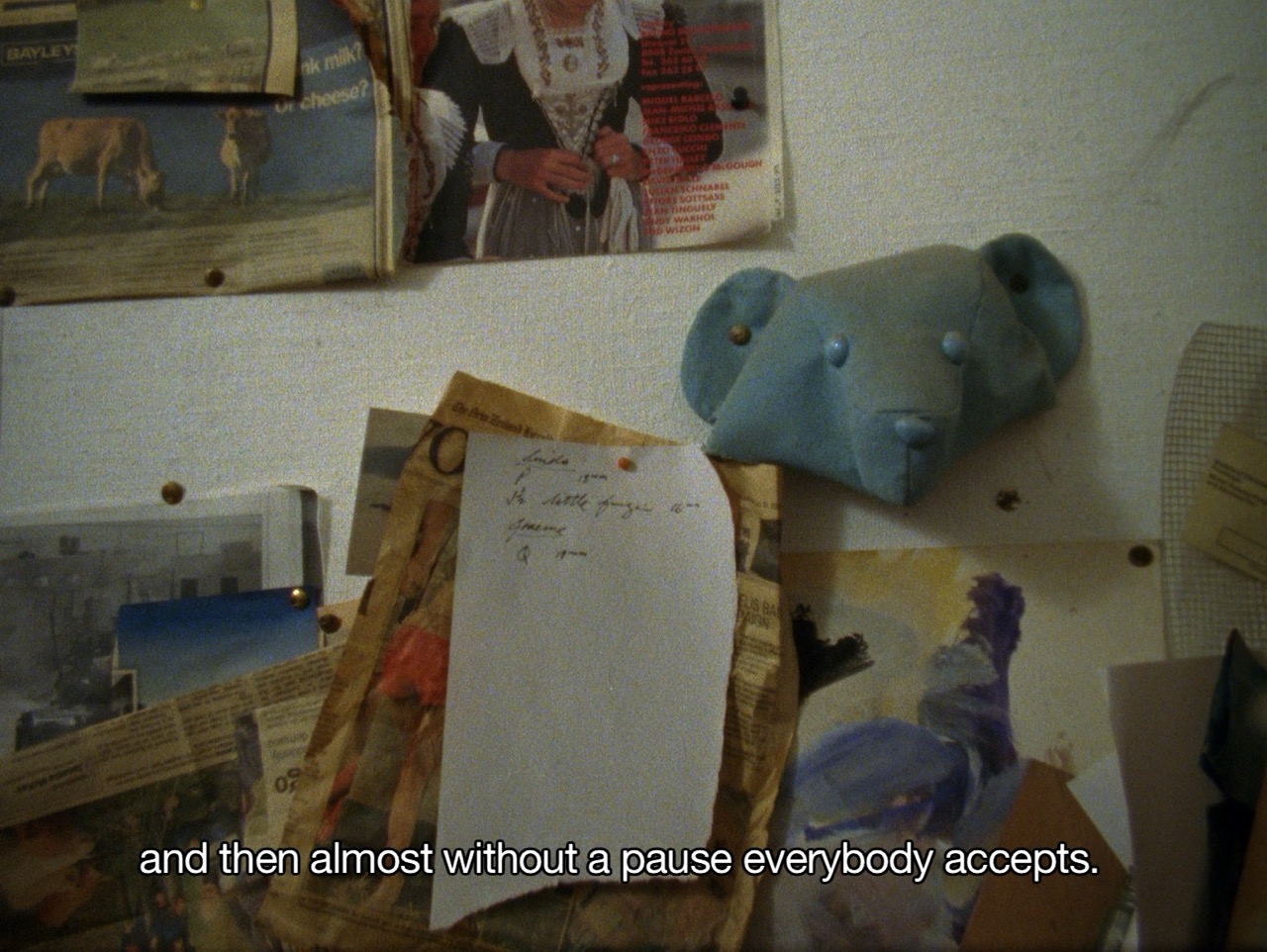
LM: I’d just finished my own MFA and so I'd had a studio at Elam l. The way you live in the school as a student can feel very intense but also ephemeral because you're kind of camping. I was drawn to the layered permanence in Graeme’s space, which was so rich and alive with practice. Unintentionally, it modelled what an artist's workspace might look or feel like.
I’d read Brian O’Doherty’s Studio and Cube, which is about this question of where an artwork might reside, and the relationship between where art is made and where it is shown. During my own art education, there was this prevailing idea that we were in a post-studio era. I think we all realise now that of course artists need studios, and that this question of what a studio might look like, or what it can be, is no longer very important. But, in the early 2000s, that was a discourse.
I found Graeme's space so compelling as an anchor that had physically lived through all of those debates about what a studio is or what an artwork is not. I also liked that it was full of things in process. Nothing in there is an artwork yet.
With time, Sculpture/Metal has become a portrait of Graeme's work because he didn't tend to make exhibitions. Many people, including Graeme and his family, have received my film as a celebration and acknowledgement of his artistic self in a way that perhaps didn't get acknowledged in that institutional setting.
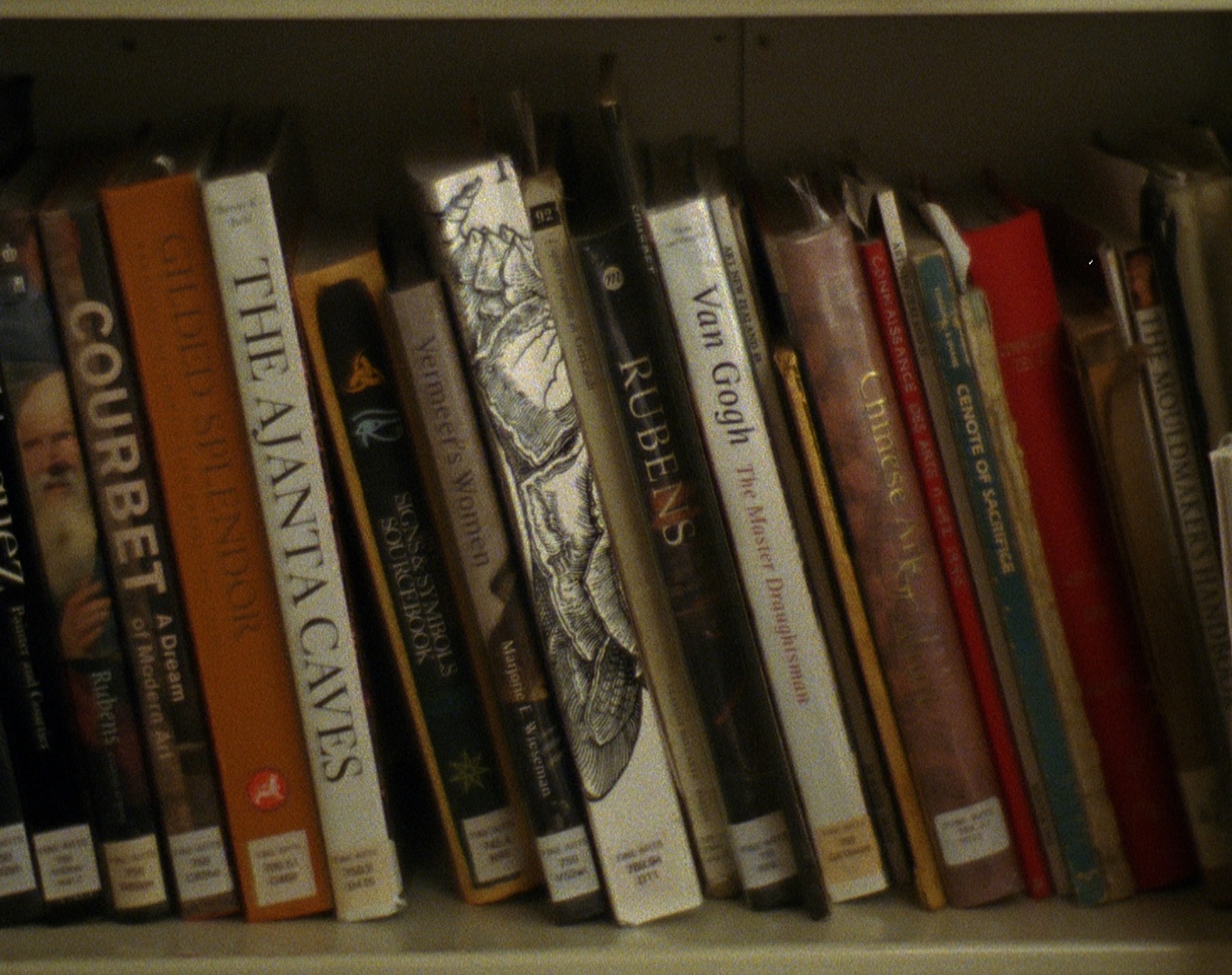
Chartwell: In the film, we see Graeme’s bookshelves full of canonical names like Dürer, Anthony Caro, Van Gogh, Rubens, and Joan Jonas. Your inclusion of these books frames the art school as a place where artistic genealogies are inherited.
LM: I was thinking a lot about my relationship with art history. How do images stay with us and shape what we see? Is it possible to reorient one's own art history? Why have we each received the images that we have? Art history is always about representation. In an education setting, this means that straight away you're having a conversation about point of view, about location, about visuality and subject experience.
In Sculpture/Metal, art history is presented as a form of intertextuality. It is the result of an iterative approach — of looking, and then looking again. There is a figuring out going on in that space that models something fundamental about visual thinking, and those aspects of practice that sit outside language. The way Graeme would have books left open, giving some extra presence to what were often highly romantic works, is a direct example for me of this way that images speak with us. But what they might mean to each of us can be harder to know, to convey.
I think it’s part of the reason we might be drawn to look at or work with something repeatedly. This is part of what I'm getting at with the Gertrude Stein quotes in the film’s text. When combined with the other text fragments, these themes of looking and influence are certainly there.
Chartwell: Shortly after you made Sculpture/Metal, there was a restructuring process at The University of Auckland that affected technician roles such as Graeme's. Several years later, the University closed the Fine Arts Library. Last year, art history was dropped from the high school curriculum. It feels like Sculpture/Metal gathers unanticipated meanings and resonances with each passing year.
LM: Yes it’s true. Another example would be studio space. It does feel that’s reduced over the years to the point where it noticeably affects how and what kind of work is made. This erosion of resources due to things like the corporatisation of the university together with conservative attitudes at a state level can feel really confronting when we consider the overall infrastructure of arts education. It can feel hard to know how to go about trying to shift these systemic issues around how the arts are understood and cared for, and so I’m really grateful for gestures like the current show at Artspace, CRIT: Art Learning since 1987, that brings us some perspective on the current climate we’re in.
Chartwell: In her essay “The Ambivalence of Authority,” film scholar Erika Balsom paraphrases Stan Brakhage, arguing that the commercial obsolescence of the film camera does not spell the end of analog film. Instead, as Brakhage suggests, “Its life is truly all before it.” What was your relationship to 16mm at this point in your practice?
LM: I disagree with the view that film is an anachronistic medium. Sometimes using a material that's outside of the current technical mainstream can reveal so much more about what it means to make an image, and what it means to look at something. When you see something shot on film, I think you look differently at what you're being shown.
Sculpture/Metal was made in the midst of a run of 16 mm films that I created over a five-year period, until it became too difficult once the local labs closed. I didn't find it workable to process everything internationally, but that doesn't mean that I won't return to it in the future. I recently spent some time in Melbourne where spaces like the Artist Film Workshop make working with film feel more accessible again. I also love noticing the revival of 16mm within contemporary cinema.
Chartwell: How did you arrive at the film's visual language: the slow pan and tilt movements that evoke a searching gaze?
LM: I'm very open about the fact that I approach filmmaking not as a filmmaker, or with a traditional tuition in that medium. I'm quite comfortable about an artwork being a place to learn. In that way, sometimes my films are more akin to a kind of drawing or looking than filmmaking in a traditional way.
When I make a film, I use video to storyboard the shots I want to take and to think through the subject. So I would have produced a range of video studies of the space, thinking about what I wanted to capture. During that time I also would have been working through a writing process thinking about the script — I knew that I wanted to bring more information to the images .
The experience of looking through the camera is also meaningful for me. The very nature of having to work a bit more slowly, having to navigate an eyepiece, to set up a shot, to use a lens, all of these steps in the process create a way of making a work that's different, not just the contrast with video, but any other way of making an image. I enjoy the slowness of that process, and I enjoy the risk. I like the planning of it all. In terms of the shot construction, it was very much dictated by the physical conditions of Graeme’s office — a really small physical area that was crammed with stuff!
Chartwell: Were you influenced by Tacita Dean's film studies of artists?
LM: I would say the films of Rosalind Nashashibi and Mario Garcia-Torres were important influences for me at that point in time.
Garcia-Torres is a Mexican artist whose works look to the artistic legacies of Arte Povera and conceptualism. His film Some Places I Have Seen Before Moving to L.A. (2005) had caught my interest in the way that an image can slip between something we know from representation versus something we know from experience. It had been my companion during the film I’d made directly prior to Sculpture/Metal — which was centered on the potted palms in St Kevins Arcade, through an art historical point of view. “Centre-periphery” relations are an enduring topic when you live somewhere like Aotearoa. Practices like Julian Dashper’s speak so eloquently to this issue.
Nashishibi’s works have been shown locally a number of times now, but the first film I ever saw was This Quality (2010) — an enigmatic portrait of a woman's face intercut with street shots of Cairo. It was one of those works that just got me. There is a serendipity to how Nashashibi has since made several works about the nature of a creative life. Vivian's Garden (2017) would be the culmination of this genre for me. It's a film about Vivian Suter, a Swiss painter who moved to Paraguay with her daughter, where Nashashibi travelled to make a film of her in her home.
Chartwell: There's a clear relationship between Sculpture/Metal and In An Orange My Mother Was Eating, your most recent film, which focuses in part on Pascal Harris, the son of Jeffrey Harris and Joanna Margaret Paul. The idea of looking at a child as part of an art life feels very significant for anyone thinking about the changing definitions of the art life, which is a recurring subject for you.
LM: I think it's a super valid subject. There are myths about an artist's life, narratives about what that might be and sometimes the reality is very different.

