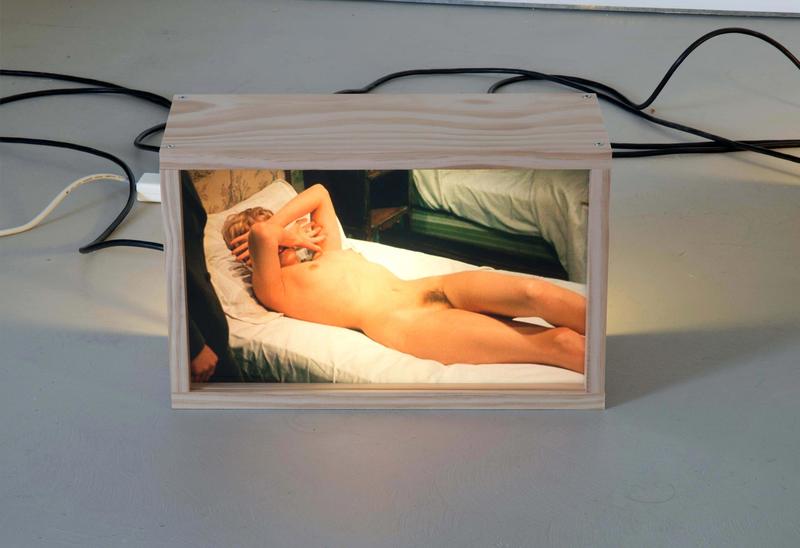

Tahi Moore, Unexpected expression in a Bunuel film, 2012, duratrans print in custom light box, Chartwell Collection, Auckland Art Gallery Toi o Tāmaki.
To mark 50 years of creative impact, The Chartwell Project and Auckland Art Gallery Toi o Tāmaki co-published Being, Seeing, Making, Thinking: 50 Years of The Chartwell Project. This book features 150 artworks from The Chartwell Collection, each selected to reflect The Collection's evolution and vision over five decades. The Appendix extends this story. This ongoing series of artist interviews highlights voices not included in the book, offering deeper insight into individual practices and the wider significance of The Chartwell Collection.
Tahi Moore is an Auckland-based artist whose videos, sculptures, paintings, and performances explore how meaning is formed and unravelled, often adopting narrative conventions, moments and phrases from philosophy, literature, film, and popular culture. In 2023, Moore published his debut book Yet Another Book About the Meaning of Life, which can be purchased through Amazon.com.au. Unexpected expression in a Bunuel film is one of five Moore works in The Chartwell Collection. It was first exhibited in 2012 at Hopkinson Mossman as part of the solo exhibition Abstract sequels, returns.
Chartwell: Your artwork Unexpected Expression in a Bunuel Film appropriates a still frame from Luis Buñuel’s 1974 surrealist comedy The Phantom of Liberty. Do you recall the moment in the film in which this “unexpected expression” occurs?
Tahi Moore: No, I only remember the process: finding a moment in a film where a picture appears that is doing something independently of the film, an image that works on its own, doing something else entirely.
Chartwell: Can you elaborate on how that process works?
TM: Mostly it’s about digging for gold. I watched movies, and sometimes images would come up that just do something. The one I remember best is from a Jean-Luc Godard movie where there’s a bank robbery, and the bank robber and the guard have a relationship. Then she rejects him, and he’s trying to come to terms with it while still living with her. He’s just sitting on the floor, and she swishes her hair, and there are two images of him reflected in her hair. There’s this really tight, self-contained thing that happens with the two images, almost like a two-image narrative.
Chartwell: The Phantom of Liberty uses a hyperlink narrative — separate storylines intersecting non-linearly. Your exhibition-making at the time of Unexpected Expression in a Bunuel Film operated through similarly associative logic. Did you have that relationship in mind when you were watching the film?
TM: I think I was just looking for images. I like that I’ve forgotten the movie, yet the image still works on its own. For me, the artwork sits somewhere between saying something specific and being meaningless. It jumps around, oscillating, imminent to meaning but never fully defined. So there’ll be a lot of things that work, but when I come back to them, they’ve gone flat. For example, I had a bunch of artworks that were just fashion magazines. I had them for a few years, and at some point they just stopped working. They weren’t quite doing something, but it looked like they might start. That’s the danger of seductive images — do they just look good, or are they doing something undecidable? Sometimes they can seem the same.
Chartwell: In your exhibitions, there are often suggested narratives alongside a refusal of linearity or a singular storyline. Yet there’s also an acknowledgment that pattern and narrative-building is a process we can actively engage in. How do you see this tension playing out in your work?
TM: I can tell you what it is: I thought I was describing reality, but in fact, I’ve got a developmental disorder in my brain. It’s fractured. My self-narrative and my narrative of the world are collapsing, and you get these little bits that start coming together, but it doesn’t really mesh.
Chartwell: Why did you start working with lightboxes?
TM: It’s a format for showing images, so there’s a built-in framing. They’re homemade, out of wood and glass, which makes them as archival as possible. Also, with a lightbox, you do just one, whereas with a photo, you do a series. I also like the empty frame.
Chartwell: Other lightbox works you’ve exhibited have featured stills from films such as Ken Russell’s Women in Love and Godard’s Passion. Each of these film moments centres on an eroticised subject. What do these images share in how they operate beyond the immediate context of their source films?
TM: When things are sexualised, they’re also thingified, in a way. That objectification tends to denature humanity, but in these moments, the image instead expresses an empathy for something going on in the mind — rather than functioning as a kind of encounter with the self.
Chartwell: In recent years you’ve moved away from photo and video work, instead exhibiting text paintings and drawings, such as in your 2024 Treadler exhibition Necessary Featurette.
TM: I’m kind of a burnt-out autistic man. The images still come up. I’m trying to figure out how to do a painting, which is pretty easy. But then I think, I don’t want to mount the canvas on wood, and I can’t get my brain to solve what to do about that.
Chartwell: Was your move away from making video works a result of burnout?
TM: I had a kid, I guess, and… I still have footage on my camera that I haven’t processed yet. But a lot of my work had these big, serious ideas behind it, and often the ideas weren’t really communicable as art. In that context, they weren’t all that interesting, because art moves quickly and has to work with a certain immediacy. What ends up being compelling, though, are all the smaller details that emerge from the big idea.
Chartwell: Do you look back on past work very often, or do you mostly keep looking forward?
TM: I just make things when the impulse comes. My work is really about curiosity. Things just emerge as they do. You try all sorts of different approaches, but a lot of the time, the results end up being surprisingly similar.
Chartwell: That seems consistent with your exhibitions, which explore how you make sense of relationships between things.
TM: The artwork doesn't say anything, it does something, even when you're just using words. Listen to a pop song, and it's immediate, but it only stays interesting for as long as you listen. I tend to have this thing where I go, what is that? And if there’s an answer which resolves it, then I lose interest.
I’m trying to write a story about a man describing enlightenment. It’s about the other end of the spectrum — not life without problems, but finding that the problem itself doesn’t exist. So instead of having life without struggle you still have the struggles, but life is just a conceptual framework that you can use to think about things.
Featured Artworks